
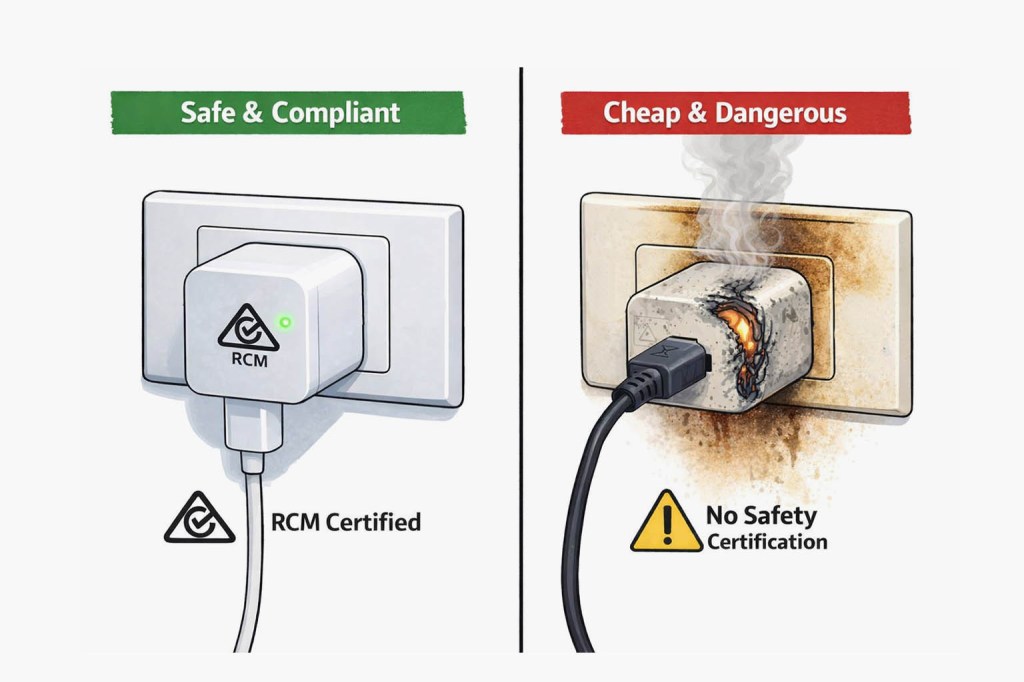
In Australian workplaces and homes, electrical safety is often taken for granted. A device plugs in, it works fine, and it becomes ‘set and forget’. Behind that convenience sits a regulatory system designed to prevent fires, electrocution, and catastrophic loss, yet alarmingly not all products meet those standards.
The Australian Competition and Consumer Commission (ACCC) regularly issues warnings about unsafe electrical products entering the Australian market, particularly low-cost imported goods sold online or through third-party retailers. These products often bypass proper compliance pathways, meaning they have not been tested to Australian safety standards and may pose a serious risk to users.
The Risk Is Real
In March 2026, a family on Sydney’s Northern Beaches lost their home after an iPhone charger sparked a fire at around4:30am while charging overnight. The blaze destroyed the property, and two occupants were taken to hospital. Investigations and expert commentary pointed toward a charging device as the likely ignition source, with additional warnings issued about third-party chargers and unsafe charging practices.
This incident mirrors a worrying pattern across Australia, where lithium-ion batteries and low-quality charging equipment are increasingly linked to residential and workplace fires. In similar cases across NSW, fires have started in bedrooms where devices were left charging on bedding, materials that trap heat and accelerate ignition.
The Core Issue: Compliance
All electrical equipment legally sold in Australia must meet strict safety requirements and carry the Regulatory Compliance Mark (RCM). This mark indicates that the product complies with Australian electrical safety standards and electromagnetic compatibility requirements.
It is not a branding exercise, it is evidence that the product has been tested and approved for use within Australian conditions.
Cheap imported products frequently lack this marking or display counterfeit versions of it. Without genuine RCM compliance, there is no assurance that the internal components are properly insulated or secured, that thermal protections are in place, or that the device can safely handle Australian voltage conditions.
The Consequences Are Well Documented
There have been multiple international and Australian incidents where substandard chargers and electrical devices have caused fatal electric shocks, particularly where insulation failure or poor internal design exposed live components. In some cases, users have been electrocuted while using devices connected to mains power through non-compliant chargers. These are not edge cases, they are predictable failures of poorly manufactured electrical goods.
From a workplace perspective, this creates a liability issue as much as a safety one. Businesses have a duty under WHS legislation to ensure that electrical equipment provided to workers is safe and compliant. Using non-compliant or unverified equipment, whether knowingly or not, can expose a business to significant risk in the event of an incident.
This is where structured inspection and testing becomes critical. Test and tag processes aligned with AS/NZS 3760 testing requirements are not just about applying a label; they are about identifying unsafe, damaged, or non-compliant equipment before it fails.
In practice, risk is identified through failed earth continuity, insulation resistance, polarity issues, open circuits, damaged leads, overheating, or equipment that cannot safely handle load conditions. Lower-quality imported devices are often exposed during testing, not because of a missing mark, but because they simply do not perform safely under Australian operating conditions.
Liberty Test & Tag sees these risks play out in real workplaces every week. It’s not always obvious or poorly labeled equipment that presents the danger, many of the highest-risk items are already in use, integrated into daily operations, and assumed to be safe.
Compliance isn’t determined by a sticker or a mark in isolation; it’s confirmed through proper inspection, testing, and an understanding of how equipment behaves in real environments. That is where unsafe or substandard products are most often identified, before they become incidents.
What Are You Really Risking?
A $5 charger that bypasses Australian standards is not a saving – it is a transfer of risk from the manufacturer to the user. That risk can manifest as equipment damage, fire, injury, or worse.
The safest approach is also the simplest: use compliant equipment, verify the presence of the RCM mark where applicable, and ensure all workplace electrical items are regularly tested and inspected through professional test and tag services.
Because when electrical safety fails, the consequences can be catastrophic.
About the Author
Mark Peters is the company director of Liberty Test & Tag, a family-owned Australian compliance provider specialising in electrical safety testing, RCD testing, and workplace compliance based in Sydney. With over 25 years of combined experience in WHS and education, Mark focuses on helping businesses implement defensible, audit-ready electrical safety systems, not just pass/fail tagging. Learn more about Liberty Test & Tag’s test and tag services in Sydney and how to keep your workplace safe and compliant.


Leave a Reply